

Air freight cost index November 2026 and outlook (see chart below)
- Northeast Asia:US$9.23/KG, 3.9% up
- Europe:US$2.77/KG, -2.8% down
- North America:US$1.88/KG, -1.1% down
Business Analytiq assumes no responsibility or liability for any errors or omissions in the content of this site. The information contained in this site is provided on an “as is” basis with no guarantees of completeness, accuracy, usefulness, or timeliness.
NEED A QUICK DOWNLOAD?
ACCESS TO OUR FULL DATABASE IS US$399/YEAR, WITH A 30-DAY $50 TRIAL
GET THAT DOWNLOAD IN 3 MINUTES!
BusinessAnalytiq provides a database of hundreds of market & price trend data, as well as online tools to set up benchmarks and leading indicators.
Air freight index
This post is a summary of air freight market developments across international transportation and logistics markets. The air freight index measures changes in the cost of transporting goods by aircraft, reflecting shipping rates for international and domestic cargo movements. Air freight rates are typically expressed in US dollars per kilogram or other applicable pricing units, depending on the route and market. Air freight index developments are calculated from multiple sources of freight pricing, airline capacity, cargo volumes, and industry data to ensure statistical accuracy and provide insights into transportation costs, shipping demand, and global trade conditions.
The outlook for air freight rates is generated from different inputs including:
-
Very recent developments in air cargo spot rates, contract rates, and freight pricing across major international routes
-
Changes in aviation fuel prices, airline operating expenses, handling charges, and other transportation costs
-
Developments in available cargo capacity, aircraft utilisation, passenger flight schedules, and dedicated freighter operations
-
Current air cargo demand, shipment volumes, seasonal shipping patterns, and supply and demand imbalances
-
Longer-term trends in international trade, e-commerce activity, industrial production, and demand for time-sensitive transportation services
What is Air Freight?
Air freight is the transportation of goods by aircraft from one location to another, either domestically or internationally. It is one of the fastest methods of moving cargo over long distances and is widely used for products that require rapid delivery, have high value, are time-sensitive or need specialised handling.
Air freight plays an important role in international trade and global supply chains. It connects manufacturers, suppliers, distributors and customers across different countries, helping businesses move products quickly and respond to changes in market demand.
Common goods transported by air include electronics, pharmaceuticals, medical equipment, automotive components, fresh produce, seafood, fashion products and high-value industrial materials.
For businesses, understanding air freight is important because transportation costs, cargo capacity, fuel prices, airport operations and international trade conditions can all influence delivery times and supply chain expenses.
What does Air Freight involve?
Air freight involves the movement of commercial cargo using passenger aircraft, dedicated cargo aircraft or a combination of both.
There are several participants involved in the air freight process:
-
Shippers: Businesses or individuals sending goods to another location.
-
Freight forwarders: Companies that arrange cargo transportation, documentation, customs coordination and delivery.
-
Airlines and cargo operators: Companies that transport goods by aircraft.
-
Ground handling companies: Organisations responsible for loading, unloading, storing and handling cargo at airports.
-
Customs authorities: Government agencies that inspect shipments and oversee import and export regulations.
-
Consignees: Businesses or individuals receiving the goods.
Air freight shipments are usually accompanied by an air waybill (AWB), which serves as a transport document containing important shipment information, including the shipper, consignee, cargo description, origin and destination.
Why is Air Freight important?
Air freight is important because it enables businesses to transport goods quickly across domestic and international markets. Although it is generally more expensive than sea freight, its speed can provide significant commercial advantages.
Businesses use air freight to:
-
Reduce transportation and delivery times.
-
Move urgent shipments and time-sensitive products.
-
Transport high-value and specialised goods.
-
Support international manufacturing and just-in-time production.
-
Maintain inventory availability when other transportation methods are too slow.
-
Reach international customers and markets.
-
Respond quickly to unexpected changes in supply and demand.
Air freight is particularly valuable when the cost of a delayed shipment is greater than the additional expense of faster transportation.
How is Air Freight measured?
Air freight activity is commonly measured using cargo volume, transportation distance, available capacity, freight rates and aircraft utilisation.
The following indicators are widely used by airlines, freight forwarders and industry analysts.
1. Cargo Tonne-Kilometres (CTK)
Cargo Tonne-Kilometres measures the volume of cargo transported multiplied by the distance travelled.
For example, transporting 10 tonnes of cargo over 2,000 kilometres generates 20,000 cargo tonne-kilometres.
CTK is an important indicator of air freight demand. An increase generally means more cargo is being transported, longer distances are being covered, or both.
2. Available Cargo Tonne-Kilometres (ACTK)
ACTK measures the cargo transportation capacity airlines make available, taking into account both weight and distance.
For example, an airline providing space for 15 tonnes of cargo over a 2,000-kilometre route offers 30,000 available cargo tonne-kilometres.
An increase in ACTK indicates that airlines are providing more cargo capacity.
3. Cargo Load Factor (CLF)
The Cargo Load Factor measures how much of the available cargo capacity is being used.

For example:
-
Cargo demand: 80,000 CTK.
-
Available capacity: 100,000 ACTK.
-
Cargo load factor: 80%.
A higher load factor generally indicates stronger utilisation of available cargo capacity.
4. Air freight rates and yields
Air freight rates measure the price charged to transport goods by air, commonly expressed per kilogram.
Air cargo yields measure the revenue generated per unit of cargo traffic, often expressed relative to cargo tonne-kilometres.
These indicators help businesses understand changes in transportation costs and the pricing environment.
IATA regularly publishes air cargo statistics covering CTK, ACTK, cargo load factors and yields.
What factors influence Air Freight rates?
Air freight prices can change significantly depending on market conditions, shipment characteristics and operating expenses.
1. Fuel prices
Jet fuel is one of the major operating expenses for airlines. Rising fuel prices can increase transportation costs and lead to higher freight charges or fuel surcharges.
2. Cargo demand and available capacity
When demand for air cargo exceeds available aircraft capacity, freight rates can increase. During periods of weaker demand and excess capacity, airlines and freight forwarders may offer more competitive prices.
3. Seasonal demand
Air freight demand often increases during certain periods, including:
-
Holiday shopping and Christmas seasons.
-
Major retail promotional periods.
-
Agricultural harvest seasons.
-
Peak manufacturing and electronics shipment periods.
-
Emergency medical and humanitarian supply movements.
These seasonal changes can influence cargo availability and freight prices.
4. Global trade and economic conditions
International trade growth, manufacturing output, e-commerce and consumer spending influence the amount of goods transported by air.
Economic slowdowns, trade restrictions and changes in international tariffs can reduce or redirect air cargo demand.
5. Aircraft capacity and fleet availability
The number of available cargo aircraft, passenger flight schedules and aircraft maintenance requirements influence the amount of cargo space available.
Air freight capacity can also be affected by disruptions to airline operations and changes in passenger travel demand, since many passenger aircraft carry cargo in their lower-deck compartments.
6. Airport congestion and handling costs
Airport congestion, cargo terminal capacity, security procedures, customs inspections and ground handling expenses can affect delivery times and total transportation costs.
7. Shipment weight and dimensions
Air freight charges are commonly based on chargeable weight, which takes into account both actual weight and volumetric weight.
Large but lightweight shipments may occupy considerable aircraft space and therefore cost more to transport than their actual weight alone would suggest.
What is chargeable weight in Air Freight?
Chargeable weight is the weight used by airlines and freight forwarders to calculate air freight transportation charges.
It is generally determined by comparing:
-
Actual weight: The physical weight of the shipment.
-
Volumetric weight: The weight calculated from the shipment’s dimensions.
The higher of the two is normally used as the chargeable weight.
A commonly used volumetric calculation is:

Where length, width and height are measured in centimetres. The divisor and rounding rules can vary by carrier and service.
Example:
A shipment has the following dimensions:
-
Length: 100 cm.
-
Width: 80 cm.
-
Height: 60 cm.
-
Actual weight: 50 kg.
Volumetric weight:
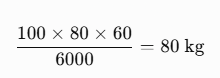
Since the volumetric weight of 80 kg is higher than the actual weight of 50 kg, the shipment’s chargeable weight would generally be 80 kg.
This explains why bulky, lightweight products can have relatively high air freight costs.
What are the main types of Air Freight services?
Air freight services are generally classified according to shipment size, delivery requirements, cargo characteristics and transportation arrangements.
1. General cargo
Standard goods that do not require special handling or temperature control. Examples include clothing, electronics, machinery parts and household products.
2. Express air freight
Fast transportation services designed for urgent shipments, documents, parcels and time-sensitive deliveries.
3. Temperature-controlled air freight
Specialised transportation for products requiring controlled temperatures, including vaccines, pharmaceuticals, seafood and certain food products.
4. Special cargo
Shipments requiring additional handling, documentation or safety procedures, such as dangerous goods, live animals, valuable cargo and oversized equipment.
5. Charter air freight
Dedicated aircraft arranged for specific cargo movements, often used for oversized shipments, urgent industrial equipment and large-volume cargo.
What is the difference between Air Freight and Sea Freight?
Air freight and sea freight are two major methods of international cargo transportation. The appropriate option depends on delivery requirements, shipment size, product value and transportation budget.
|
Category |
Air Freight |
Sea Freight |
|---|---|---|
|
Transportation method |
Aircraft |
Cargo ships |
|
Delivery speed |
Generally faster |
Generally slower |
|
Transportation cost |
Usually higher |
Usually lower for large shipments |
|
Cargo capacity |
More limited |
Very large |
|
Best suited for |
High-value and time-sensitive goods |
Heavy, bulky and high-volume goods |
|
Typical products |
Electronics, pharmaceuticals, perishables |
Machinery, furniture, commodities and industrial materials |
|
Environmental impact per tonne-kilometre |
Generally higher |
Generally lower |
|
Main advantage |
Speed and delivery flexibility |
Cost efficiency for large shipments |
Air freight is often preferred when delivery speed is commercially important, while sea freight is generally more economical for large and less time-sensitive shipments.
How does Air Freight affect businesses?
Air freight can influence business costs, competitiveness and supply chain performance.
-
Inventory management: Faster delivery can reduce the amount of inventory businesses need to hold in certain supply chains.
-
Production continuity: Manufacturers can use air freight to obtain urgent components and prevent production interruptions.
-
Customer satisfaction: Faster transportation can improve delivery performance and customer experience.
-
International market access: Businesses can reach customers in overseas markets without relying exclusively on slower transportation methods.
-
Product quality: Temperature-controlled and specialised air freight services can help preserve sensitive products during transportation.
-
Operating costs: Higher freight rates can increase product costs and reduce profit margins.
-
Supply chain resilience: Air freight provides an alternative when sea freight routes are disrupted or shipments are delayed.
For businesses, the main consideration is whether the commercial benefit of faster delivery justifies the additional transportation expense.
What should businesses monitor?
Companies that rely on air freight should monitor transportation market indicators alongside economic and trade developments.
|
Indicator |
What to monitor |
Business relevance |
|---|---|---|
|
Cargo Tonne-Kilometres (CTK) |
Changes in air cargo demand |
Measures freight activity |
|
Available Cargo Tonne-Kilometres (ACTK) |
Changes in cargo capacity |
Indicates available transportation supply |
|
Cargo Load Factor |
Cargo capacity utilisation |
Shows the balance between demand and capacity |
|
Air freight rates |
Price per kilogram |
Helps forecast shipping expenses |
|
Jet fuel prices |
Changes in aviation fuel costs |
Indicates potential cost pressure |
|
Global trade volumes |
Import and export developments |
Signals demand for cargo transportation |
|
Manufacturing activity |
Industrial production and new orders |
Helps anticipate shipment demand |
|
Airport cargo volumes |
Cargo handled at major airports |
Measures local and regional freight activity |
|
Exchange rates |
Changes in currency values |
Affects international freight expenses |
Conclusion
Air freight is an essential component of international trade and modern supply chains. It allows businesses to transport goods quickly across domestic and international markets, particularly when speed, reliability and product handling are important.
However, air freight is generally more expensive than sea transportation, making it important for businesses to evaluate shipping costs against delivery requirements and the value of the goods being transported.
Monitoring air cargo demand, available capacity, freight rates, fuel prices and cargo load factors can help companies anticipate changes in transportation costs and improve supply chain planning.
The key takeaway: Air freight is more than a transportation service. It is a critical part of global commerce that supports manufacturing, e-commerce, international trade and the movement of high-value and time-sensitive products.