
Lidocaine HCl price September 2026 and outlook (see chart below)
Business Analytiq assumes no responsibility or liability for any errors or omissions in the content of this site. The information contained in this site is provided on an “as is” basis with no guarantees of completeness, accuracy, usefulness, or timeliness.
Latest market developments for Pharmaceutical API prices for September 2026
NEED A QUICK DOWNLOAD?
ACCESS TO OUR FULL DATABASE IS US$399/YEAR, WITH A 30-DAY $50 TRIAL
GET THAT DOWNLOAD IN 3 MINUTES!
BusinessAnalytiq provides a database of hundreds of market & price trend data, as well as online tools to set up benchmarks and leading indicators.
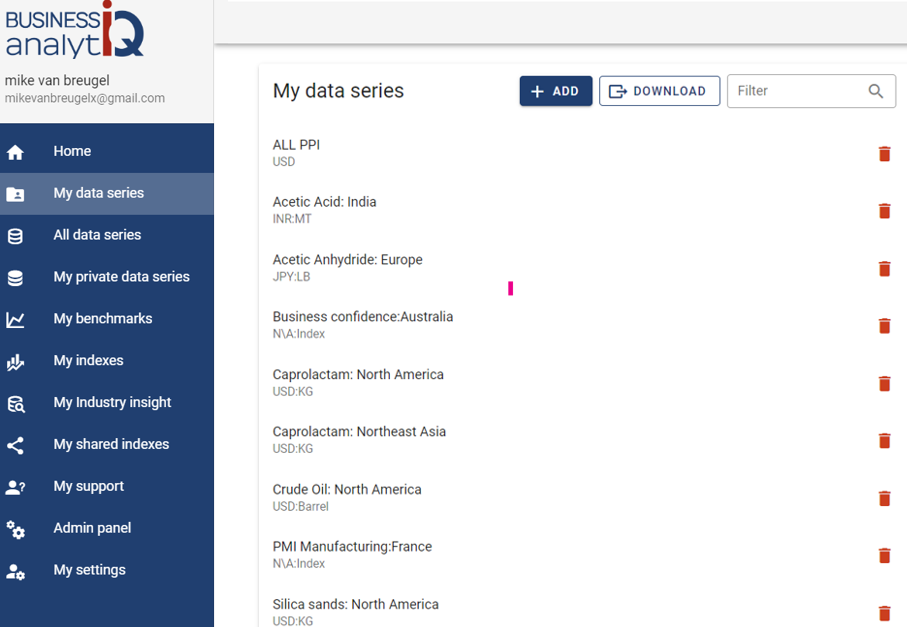
Lidocaine HCl price index
This post is a summary of the Lidocaine HCl price developments. The price developments of Lidocaine HCl are expressed in US$ prices converted FX rates applicable at the time when the price was valid. Lidocaine HCl price index developments are calculated from multiple separate sources of data to ensure statistical accuracy.
The outlook for Lidocaine HCl prices is generated from different inputs including:
- Very recent price developments of immediate cost drivers of Lidocaine HCl prices
- Recent price developments of underlying feedstocks which drive the price of Lidocaine HCl
- Market futures for both cost drives and feedstocks of Lidocaine HCl prices
- Adjustment of current supply/demand imbalances in the Lidocaine HCl market
- Longer term trends in likely demand conditions
What is Lidocaine HCl and what is it used for
Lidocaine Hydrochloride (commonly called Lidocaine HCl) is the hydrochloride salt form of the local anaesthetic and anti‑arrhythmic agent Lidocaine. It works by blocking sodium channels in nerve cell membranes, thereby preventing the transmission of pain signals from the site where it is applied.
In practice, Lidocaine HCl is used for a variety of indications: it can be applied topically (gel, cream, lotion), injected, or used in patches to numb a specific area of the body ahead of a procedure (such as dental work, minor surgery, catheter insertion) or to relieve pain from skin irritations, burns, insect bites, or nerve‑related pain (e.g., post‑herpetic neuralgia). It is also used systemically (injection) for certain cardiac arrhythmias (via its lidocaine base activity).
How is Lidocaine HCl produced
The production of Lidocaine HCl begins with the chemical synthesis of lidocaine base (an amide local anaesthetic) followed by conversion into the hydrochloride salt form for stability, solubility and formulation purposes. According to industry listings, there are many active pharmaceutical ingredient (API) manufacturers of Lidocaine HCl in countries such as China, India and Singapore. These API manufacturers supply the raw material that is subsequently formulated into creams, gels, injectable solutions, patches or other dosage forms by pharmaceutical companies.
Production also involves meeting regulatory quality standards (GMP, CEP, USDMF, etc) since the API and final formulations must satisfy safety and purity requirements.
How large is the global market for Lidocaine HCl and where is it produced
The global market size for Lidocaine (and specifically the Lidocaine HCl segment) shows variation depending on the source and definition (whether covering all formulations or just the HCl salt). One estimate values the Lidocaine Hydrochloride market at about **USD 752.5 million in 2023**, with a projected growth CAGR of ~5.5 % from 2024 to 2032. Another source estimates the broader Lidocaine market (not limited to HCl) at USD 1.7 billion in 2023, and projected to reach USD 3.5 billion by 2030.
Geographically, North America (USA & Canada) currently dominates the market for Lidocaine HCl, driven by high surgical, dental and dermatological procedure volumes. Meanwhile, Asia‑Pacific is seen as the fastest growing region due to increasing healthcare access, rising elective procedures, and a growing middle class. :contentReference[oaicite:11]{index=11}
In terms of production, major API suppliers for Lidocaine HCl are located in **China** (multiple manufacturers listed) and **India** (several prominent API producers). There are also European suppliers (for instance in Spain, Sweden) and companies supplying from Singapore.
Overall, this data indicates that Lidocaine HCl is a well‑established pharmaceutical product with a sizeable global market and a distributed production base across Asia (especially China & India) and formulated globally for use in North America, Europe and beyond.